
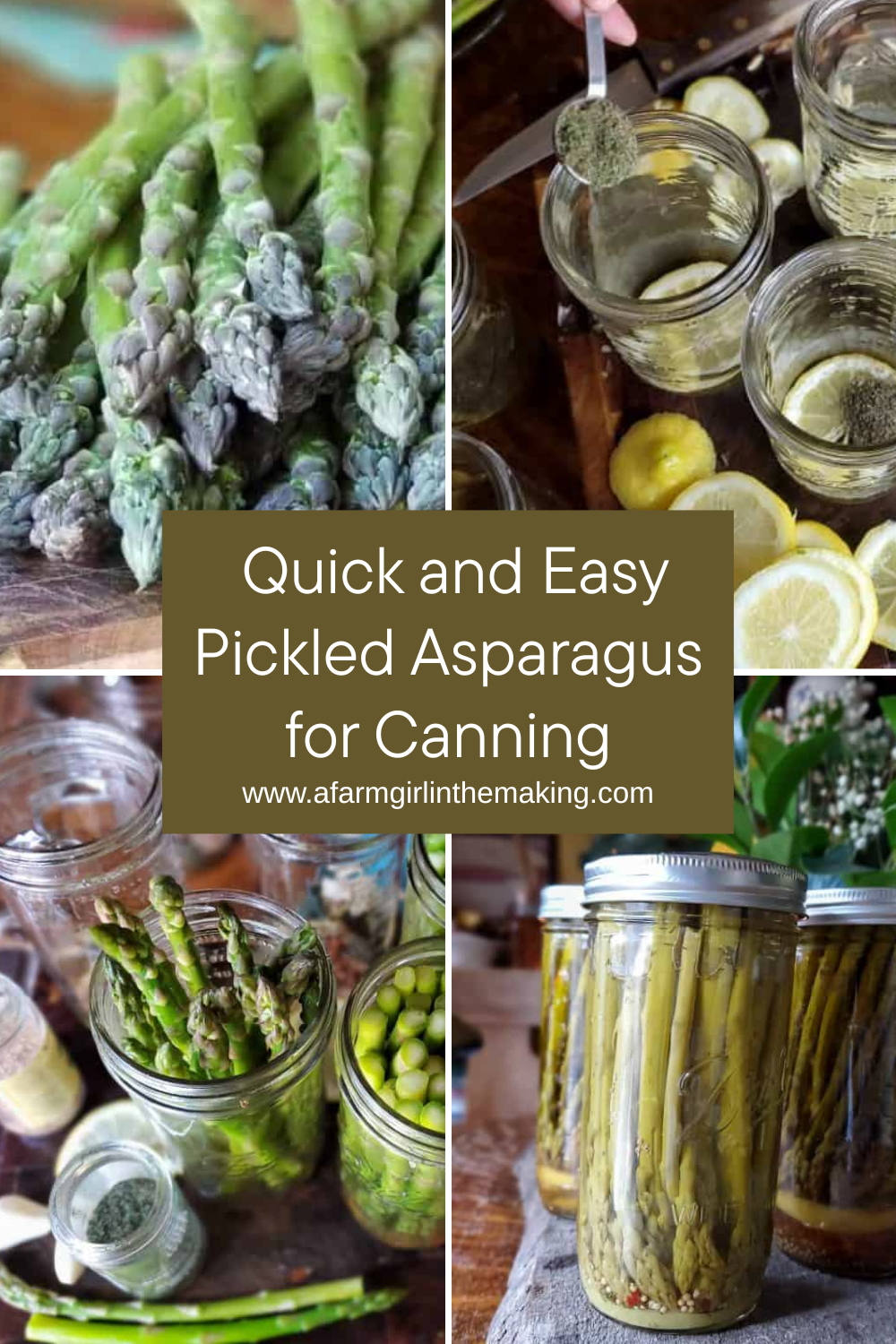
Asparagus season is a short, so don’t hesitate in preserve the harvest with this quick, easy pickled asparagus recipe for canning. This recipe shines brighter than most as the pickling brine elevates it from a tart vinegar brine to one that is smooth and delicate in flavor. Take advantage of the asparagus season by filling the larder with the best pickled asparagus recipe you’ll find.

Disclosure policy: A Farm Girl in the Making participates in multiple affiliate programs, including the Amazon Associate Program, an affiliate advertising program linked to Amazon.com and other affiliated sites. This allows us to earn a small percentage from the affiliate links you support, and for that, we thank you!
Growing and Purchasing Asparagus
If asparagus grows in your area, find the local farm that grows it. More often than not, the farms sell a percentage of the harvest to local markets in the area. Here are a few tips for sourcing fresh asparagus spears at a discounted rate.
- Buy in bulk – Many markets will offer a discount ranging from 10% to 20% discount when you purchase in bulk. We have been able to purchase mushrooms in bulk, allowing us to pressure can them for later use. I know many of you will ask why we pressure can mushrooms, and the reason is simple: storing mushrooms in a glass jar yields better flavor than those in a metal can.
- Purchase direct from a local farmer – Cutting out the middle man allows for a greater savings. Keep in mind that many small farms will also offer a discount when purchasing in bulk.
- Forage for it – Asparagus grows like a weed in many parts of the country. Foraging for asparagus spears is an economical way to enjoy the harvest.
- Grow it – A mature asparagus patch takes years to achieve. However, with patience, a patch will produce stalks for many years. A great companion plant for asparagus is strawberries. Once the transplants from the asparagus seeds you sowed or the purchased crowns are planted in the designated area, sow strawberry plants over the planted asparagus. This will allow you to enjoy a harvest of fresh strawberries as you wait for the asparagus to begin producing.
For those who have never started asparagus from seed, don’t fret, it is not as difficult as it seems. Here’s a quick article on how to sow asparagus seeds for a bountiful harvest for many years to come.

The best pickled asparagus recipe
As with anything being pickled, there are a lot of details you must keep in mind to create an outstanding product that is shelf-stable and able to be stored at room temperature.
- Select only the freshest and firmest stalks to be canned.
- Enhance the flavor of the product by experimenting with spices and herbs. Feel free to eliminate or swap out any herb or spice within this recipe. However, do not increase the amount as it can alter the pH balance within the jar.
- Be willing to experiment with different types of vinegars to create a less tart product.
As mentioned, many pickled asparagus recipes are tart in flavor, and the reason behind this is the type of vinegar used to create the brine. Generally, most pickled items use distilled white vinegar with an acidity of 5% or higher. We opt to elevate the flavor of many of our pickled items by using other vinegars that still meet the required acidity level needed to preserve the item when canned, creating a less tart product.
Size does matter when canning pickled asparagus
Choosing the best asparagus stalk and the right-sized jar ensures the harvest is preserved efficiently.
- Asparagus stalk – Choose stalks that are thick in size, as they hold their texture well during the canning process and as they sit in the cabinet waiting to be used. Thin stalks tend to become extremely soft quickly, which could affect the flavor and product within the jar.
- Jar size – Do not miss out on preserving as much of the asparagus stalk as possible. For this reason, we use 24-ounce mason jars when canning pickled asparagus. Of course, the spears can be cut into bite-sized pieces to fit quart jars; however, the aesthetic appeal is no longer present. And for pickled asparagus, presentation is everything. A jar this size is ideal for long spears, which in turn make a great addition to a charcuterie board, in a Bloody Mary, paired with a perfectly grilled steak, or eaten straight from the jar.
Feel free to store your jars when they are empty. However, we use them for drinking glasses until the next preserving season.

Selecting the best vinegar option
Home-canned pickled items, including this recipe, require the vinegar to be 5% acidic or higher. This opens the door for many items to be canned using vinegars such as:
- White and red wine vinegar
- Rice wine vinegar
- Champagne vinegar
- Apple cider vinegar
- Balsamic vinegar, as long as it is not an aged balsamic vinegar
- and of course, distilled white vinegar
It is essential to check the back of a bottle of vinegar each time you purchase a bottle, making sure the product within the jars is 5% acidic or higher.
Bottled lemon juice and fresh citrus
The pickling process requires the use of an acidity booster, whether it is in the form of a vinegar or citrus juice. I have recently learned that a few brands of bottled citrus juices (lemon and lime) no longer list the acidity level on the labels or jars. In referring to the brand’s website, the acidity level of their product is not mentioned either. In this case, feel free to substitute any of our recipes that call for bottled lemon juice with a vinegar from the list above.
Fresh lemons or bottled lemon juice can be used to add flavor to the contents within the jars, like the lemon slices added to the pickled asparagus jars, but should not be used to ensure the acidity level is correct.
Pickle recipes worth trying
I can talk all day long about this pickled asparagus recipe, though it would be fair to allow the pickled items below to shine as well.
- Pickled golden beets
- Old-fashioned bread and butter pickles
- Traditional dill pickles
- Cowboy candy – sweet pickled jalapeno peppers
- The BEST refrigerator pickles
Quick and easy pickled asparagus recipe for canning
Below is a quick list of ingredients and supplies you’ll need. Included is a printable recipe card for you to utilize and keep for future reference.
Ingredients
- Asparagus – 10 to 15 pounds, depending on the size of the spears
- White wine vinegar (5% acidity) – 4 1/2 cups
- Water – 4 1/2 cups
- Dill weed, dill seeds, or fresh dill – 10 tsp
- Fresh garlic – 10 cloves
- Whole mustard seeds – 10 tsp
- Crushed red pepper flakes – 10 tsp
- Fine sea salt, pickling salt, or any anti-caking – 1/2 cup
- 2 fresh lemons
Notes
- The white wine vinegar can be swapped for distilled vinegar (5% acidity)
- Celery seed can be swapped for dill seeds
- And pickling spice can be used in exchange for the dried dill weed, whole mustard seeds, and crushed red pepper flakes. I do not use pickling salt, but use this anti-caking salt instead. If you want to try this anti-caking salt from Redmond, use the code afarmgirl to receive 15% off your order.
Canning tools
- Hot water bath canner (aka boiling water canner) or a steam canner
- Jar funnel and air bubble remover
- Heavy-bottomed large pot for the brine
- Stainless steel jar funnel
- Canning tools – magnetic lid lifter and jar lifter
- 25-ounce wide-mouth tall jar (10 jars)
- Canning lids, selected from a reliable company
Additional kitchen tools
- Stainless steel or glass mixing bowl
- A colander
- Stainless steel slotted spoon
- Measuring cups and spoons
- Little dipper melting pot to warm lids


Canning instructions
The following tips will guide you to a seamless experience during the canning process.
Prepare the jars
Best practices recommend using clean, hot jars, and there are two methods to achieve this. The thought process – hot jars, hot brine, hot water in the canner will minimize jars from cracking while in the canner due to heat shock, while sterilizing them.
Utilizing a dishwasher. This method will require you to plan your canning time accordingly.
- Place your jars into the dishwasher to wash and sanitize them.
- Once the washing process is complete, immediately begin the canning process, leaving the jars in the dishwasher until they are ready to be filled.
Boiling water bath. This method allows you to be more flexible with your time.
- Hand-wash the jars and set them aside.
- Fill the very large stock pot or hot water bath canner halfway with water, and add the canning jars. Add additional water as needed to ensure the jars are covered.
- Bring the pot to a boil. Once the water has begun to boil, set your timer for 10 minutes. As the jars are boiling, begin preparing the brine.
- After 10 minutes, carefully remove the canning jars and place them onto a dishtowel.

Prepare the asparagus
Slightly blanching the asparagus will do three things: It makes the vegetable more pliable, opens the pores, allowing the brine to absorb into the spears, and minimizes further shrinkage and floating during the canning process.
- Wash the asparagus spears well, and remove the woody end of the the spear.
- In a stainless steel or glass mixing bowl, add cold water and 3 cups of ice cubes. Set the ice water aside.
- In a stock pot, add water and bring to a boil. Add the clean, trimmed asparagus to the pot and boil for 20 seconds.
- Using a slotted spoon, remove the asparagus spears from the boiling water and place them into the bowl of ice water to stop the cooking process.
- Once cooled, remove the asparagus from the water and place them into a strainer.
Prepare the brine
- In a short stock pot, add the water, white wine vinegar, sugar, and salt.
- Set the burner to medium-high, and stir the mixture until the ingredients dissolve.
- Lower the heat to medium-low, and begin preparing the jars
Prepare the canner
- Fill the hot water bath canner 3/4 of the way full. Place the canner lid onto the canner and bring the water to a boil. Once a soft boil starts, begin filling your jars.
- When using a steam canner, it is best to add the water to the tray of the steam canner and then begin filling your jars. Once the canner is full, set the burner to high and place the dome lid onto the canner. Your processing time will begin once the steam releases from the whole of the lid at a strong and steady pace. Refer to the cart below for the correct processing time based on the altitude at which you reside.
Fill the jars
For those who cannot attend our hands-on canning workshops on the farm, the Sustainable Canning Course was created with you in mind. This online canning course with videos is a self-paced online workshop designed to help you achieve food ownership. The course is yours to keep for a lifetime, allowing you to reference it as often as you need.


Only fill as many jars as will fit into a hot water bath or steam canner at a time. Keep jars and brine warm during the canning process. Once the jars have completed the processing time, begin filling additional jars. Continue this process until the the ingredients are used up.
- In each 24-ounce canning jar, add 1 lemon slice, 1 tsp dill weed, 1 tsp mustard seed, 1 tsp crushed red pepper, and 1 garlic clove. Finally, add the asparagus to each jar with the top of the spear facing downward into the jar. Make sure there is at least a 1-inch space between the bottom of the asparagus and the top of the jar.
- Using a stainless steel jar funnel, add the brine to each jar, ensuring the spears are covered, and that there is a 1-inch gap between the brine and the top of the jar.
- With an air bubble remover, gently remove any air that may be trapped within the jars.
- Using a clean, slightly damp dishcloth, wipe the jar rims.
- Add the warm lids and rings to finger-tight. Place the jars into the hot water bath canner or steam canner, and begin the processing time.
- Utilize the chart below to determine the processing time based on the altitude at which you reside
The processing time
The processing time for any foods preserved through home canning is determined by the altitude at which you reside. To find your altitude, do a Google search. Add your address and the words “find my altitude” into the search bar.
The chart below shows the processing time for this canning recipe based on your altitude.
| Process Time at Altitudes of | ||||
| Style of Pack | Jar Size | 0 – 1,000 ft | 1,001 – 6,000 ft | Above 6,000 ft |
| Hot | 24-ounce jars | 15 mins | 20 mins | 25 mins |
Take a minute and PIN this recipe to your CANNING board on Pinterest!
Recipes can get lost easily. Take a minute to PIN this quick and easy pickled asparagus recipe for canning to your CANNING board on Pinterest.

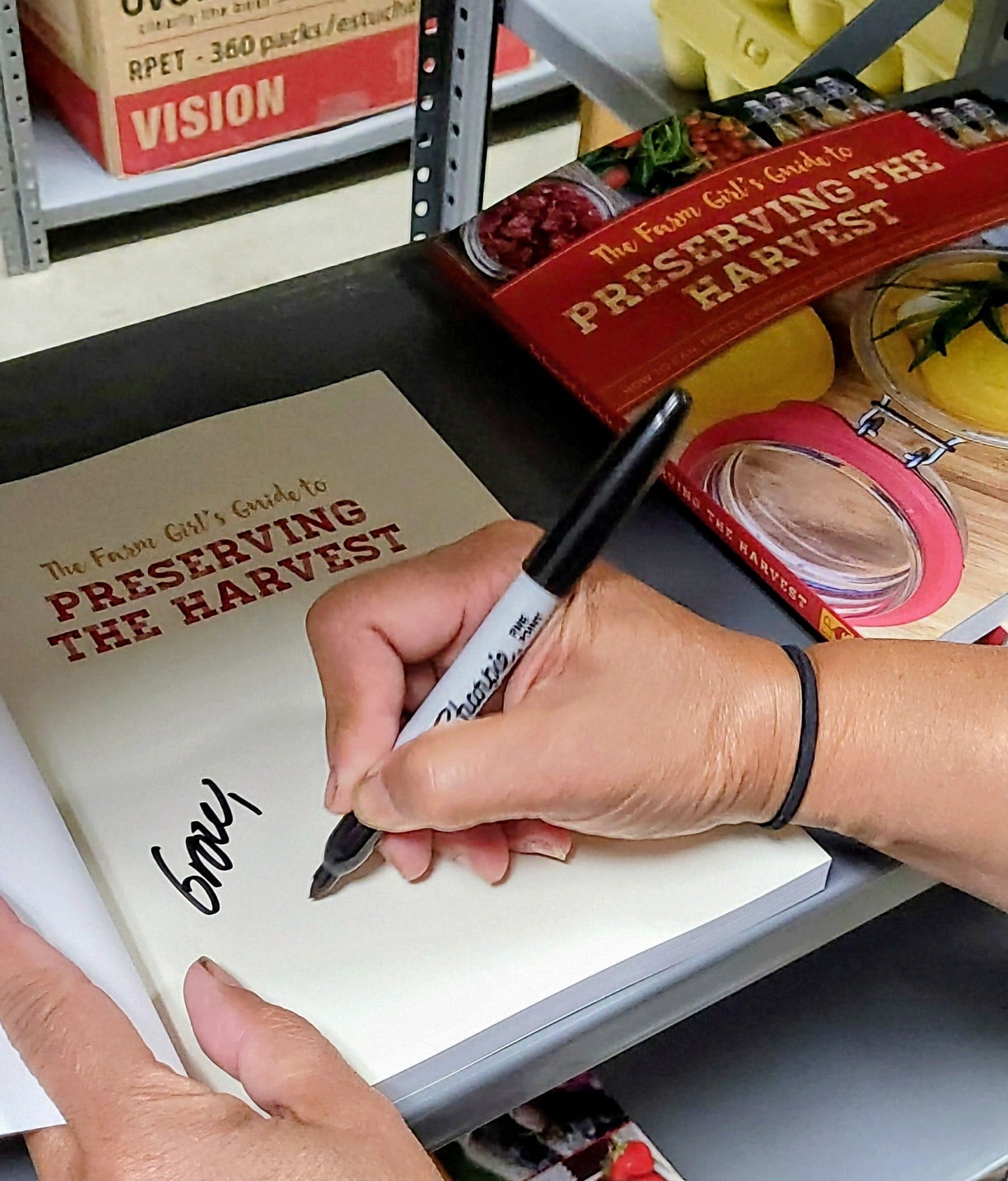
Grab a copy of my book, The Farm Girl’s Guide to Preserving the Harvest, or join The Sustainable Canning Course
The Farm Girl’s Guide to Preserving the Harvest is a comprehensive book that covers multiple methods for preserving food in the comfort of your home. Learn how to can, dry, ferment, cure, freeze, and store foods fresh as a sustainable homesteader would. The tips, tricks, and recipes in this book will give you the confidence and knowledge to own your food source and feed your family healthy food options throughout the year.
The Sustainable Canning Course is an extension of my book, The Farm Girl’s Guide to Preserving the Harvest. I wrote this book to help guide those who seek to own their food source and provide them with the opportunity to do so. This online course with video contains:
- Understand why hot water bath and pressure canning are necessary to preserve foods
- Confidently alter or create recipes to be canned
- Preserve many tomato products utilizing scientific information with traditional tools
- Utilizing modern canning tools, such as the steam canner and steam juicer
- Understanding how to decipher information shared by the National Center of Home Food Preservation
- Discover how easy it is to can meat, fish, soups, stews, and wild game, as well as pickled items, and jams and jellies
Printable Recipe – Pickled Asparagus Recipe
For your convenience a printable recipe card is available. I truly hope you enjoy my blue ribbon pickled asparagus recipe!
This recipe is unlike any other. Also, this pickled asparagus recipe is a million times better than what you can buy at a local market! Enjoy it, friends. And if you’re feeling generous, share a jar or two.
Canning Pickled Asparagus

A pickle asparagus recipe that can be canned or refrigerated and enjoyed throughout the year. What elevates this recipe above others is the type of vinegar used, a smooth vinegar that eliminates the tang, yet is high enough in acidity to make this pickled asparagus recipe above all others
Ingredients
- 10 pounds of fresh asparagus
- 4 1/2 cups white wine vinegar (5% acidity)
- 4 1/2 cups water
- 10 teaspoons dill weed
- 10 cloves fresh garlic, peeled
- 10 tsp whole mustard seeds
- 10 tsp crushed dried red pepper
- 1/2 cup pickling salt
- 1 whole fresh lemon
Instructions
- Warm canning lids in hot water; we prefer the Little Dipper for this task.
- Prepare the hot water bath canner or steam canner by adding water and bringing the water to a boil. Please note that if you are using a steam canner, turn on the burner after step 6 is complete.
- Prepare a bowl with cool water and set it aside. The cool water will be used in step 5.
- Wash and remove the wood end of the asparagus.
- Wash the lemon, and evenly slice the lemon into coins, making sure to discard the stem and blossom ends, and set aside.
- Add 8 cups of water to a shallow stock pot and bring to a boil. Next, add the washed and trimmed asparagus spears to the boiling water, and allow the spears to boil for 30 seconds. Once blanched, remove the spears with a slotted spatula and place the in cold water to stop the cooking process. Set the cooled asparagus aside, and move on to step 7.
- In a stainless steel or heavy-bottom pot, prepare the brine. Add the white wine vinegar, water, sugar, and salt, and bring the to a slight boil. Hold the temperature until steps 7, 8, and 9 are completed.
- In hot, sterilized jars (we prefer 25-ounce wide-mouth jars), add 1 freshly sliced lemon to each jar.
- Working quickly, add 1 teaspoon of dill weed, 1 teaspoon of mustard seed, 1 teaspoon of crushed red pepper, and 1 peeled garlic clove.
- Next, add the blanched asparagus spears to the jars, making sure the tops are facing downward in the jars. Pack the jars as tightly as possible.
- Increase the temperature of the burner, and bring the brine to a hard boil. Once the hard boil has been reached, add the brine to each jar, leaving a 1-inch headspace.
- Using an air bubble remover, remove any air bubbles that may be trapped in the jar. Add additional brine if needed, making sure to leave a 1-inch headspace.
- Using a clean dishtowel, wipe rims of each jar, add the warmed lids and rings (rings should be applied finger tight).
- Process the jars for the appropriate time based on your altitude. See the blog for the correct processing time based on the altitude at which you reside.
- At the end of the processing time, remove the jars of pickled asparagus and place them onto a towel to cool. Allow the jars to cool for a minimum of 12 hours prior to checking to see if the lids have sealed to the jars.
Notes


